Pinout & Plate may earn a commission on custom keyboard parts bought through our links at no additional cost to you. How Pinout & Plate earns affiliate commissions
Upgrading to a custom keycap set is one of the most effective ways to alter the visual presentation, illumination quality, and surface feel of an RGB mechanical keyboard. However, not all keycaps handle backlighting the same way. The final aesthetic depends heavily on three mechanical parameters: the base polymer material (such as textured PBT versus optical-grade Polycarbonate), the illumination delivery style (etched contour lines, frosted pudding skirts, or total transparency), and the sculpt profile (OEM versus Cherry height).
Quick Selection Path
- For subtle, high-contrast glow with a textured grip: Choose PBT Contour Shine-Through caps in Cherry profile.
- For maximum RGB output and switch visibility: Choose Fully Transparent Polycarbonate (PC) sets with high key counts.
- For ambient backlighting with durable tops: Choose PBT Pudding Keycaps in OEM profile.
PBT Contour Shine-Through: Textured Surface with Topographic Illumination
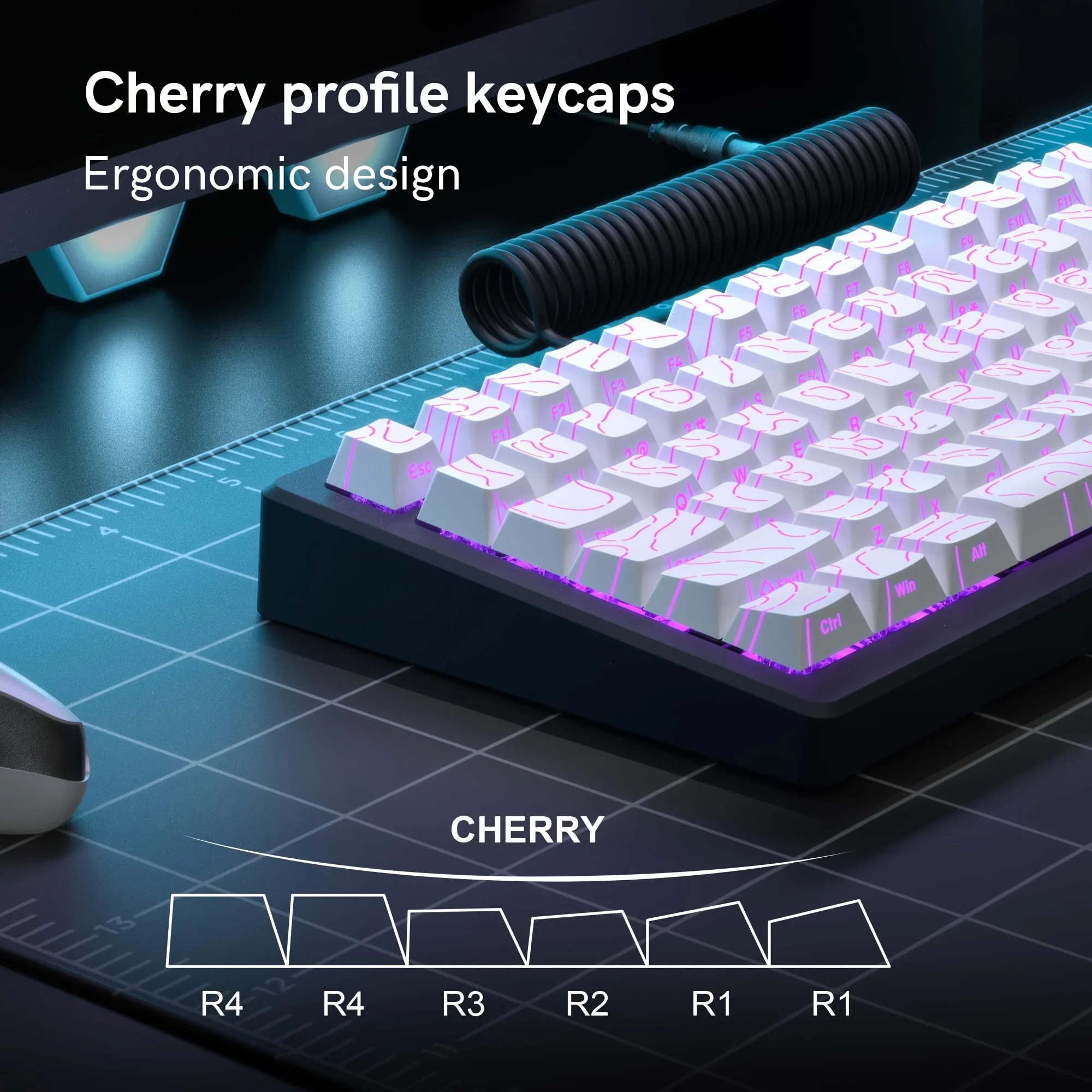
The primary pick for builders seeking a balance between surface durability and custom lighting accents is the Contour Shine-Through Keycap Set. Rather than illuminating only traditional alphanumeric characters, this set incorporates etched topographic contour lines across the top and side surfaces of each keycap, allowing backlighting to trace geometric patterns across the entire board.
According to listing specifications, these caps are molded from PBT (Polybutylene Terephthalate) and advertised as oil-resistant, designed to resist the surface shine and finger-oil buildup common with standard ABS plastics over extended use. Pictured specifications indicate an ergonomic Cherry profile sculpt, which utilizes progressive row heights (ranging across R1 to R4 steps) for a lower, angled typing posture compared to standard OEM keycaps.
Fully Transparent Polycarbonate: Maximum Light Transmission
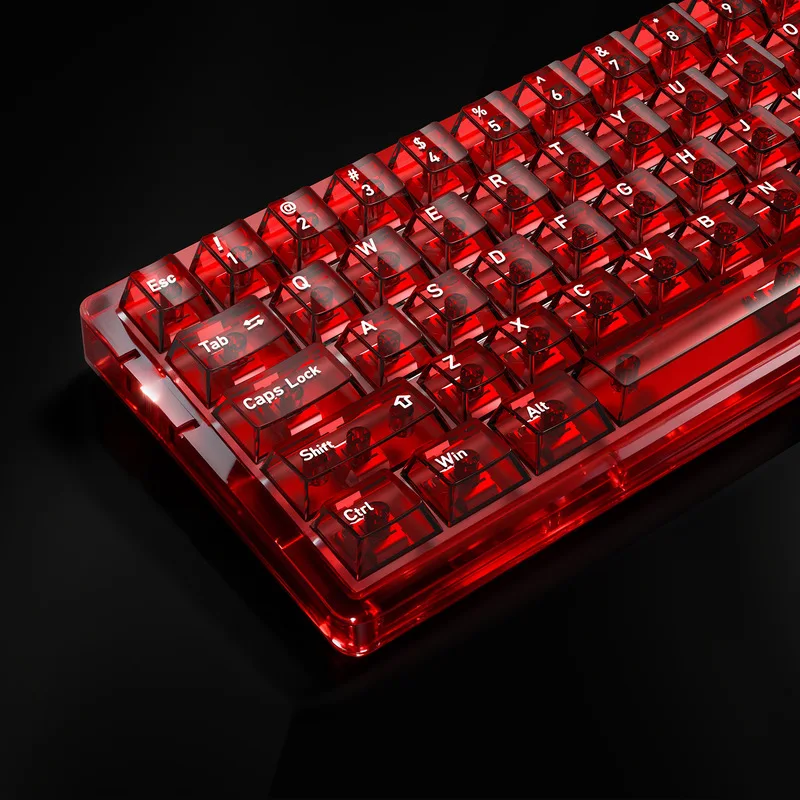
If your build priority is raw light pass-through and showcase visibility for switch housings, clear polycarbonate construction is the standard alternative. The 136-Key Multilingual PC Transparent Keycap Set replaces opaque plastic entirely with glossy, clear-tinted polycarbonate (available in tinted variants such as transparent red).
Unlike standard caps where light is restricted to the legend cutout or switch perimeter, fully transparent PC allows internal LED backlighting to illuminate the entire key body and internal stem cross. Pictured details show high-contrast printed top legends alongside multilingual sub-legends (with options listed for English, Japanese, Russian, and Korean layouts).
The 136-key stated inventory provides broader compatibility for non-standard bottom rows, compact 65% or 75% layouts with non-standard right shift keys (such as 1.75u sizes), and full-size layouts. However, transparent PC features a smooth, glossy surface rather than the matte micro-texture found on PBT sets, which changes the tactile feel under the fingers.
PBT Pudding Keycaps: Dual-Layer Diffused Glow
For builders who prefer standard legend legibility combined with widespread underglow, dual-layer "pudding" keycaps offer a functional compromise. The OEM PBT Pudding Keycap Set utilizes a two-piece design: an opaque, textured black or white PBT top surface to maintain fingertip grip, bonded to frosted translucent side walls.
This construction acts as a diffuser, scattering the direct LED beam from the switch into an even ambient halo around every switch perimeter while retaining crisp shine-through alphanumeric legends on top. The listing specifies an OEM profile, which features slightly taller key heights and steeper row angles than Cherry profile sets. Stated compatibility spans common mechanical layouts, including 68, 75, 80, 95, and 108-key form factors.

Keycap Comparison & Physical Specifications
The following table summarizes the advertised materials, profiles, and lighting properties based on provided merchant data to assist in matching keycaps to your mechanical keyboard build:
| Keycap Set | Stated Material | Profile | Illumination Style | Stated Layout Coverage | Reference Price |
|---|---|---|---|---|---|
| Contour Shine-Through | PBT (Oil-Resistant) | Cherry | Topographic Line Glow | Standard layouts (check listing) | $11.48 |
| Transparent Multilingual | Polycarbonate (PC) | Cherry | 360° Full Transmission | 136 Keys (Expanded support) | $17.26 |
| PBT Pudding | PBT + Frosted Base | OEM | Dual-Layer Diffused Walls | 68, 75, 80, 95, 108 Keys | $13.64 |
Pre-Purchase Compatibility Checklist
Before purchasing any aftermarket keycap set, verify the following mechanical clearances against your current keyboard:
- Stem Standard: Ensure your switches use standard MX-style cross (+) stems. All three sets feature MX stem mounts.
- Right Shift & Bottom Row Sizing: Compact layouts (65%, 75%, and 96%) frequently require a 1.75u right Shift key and 1u bottom-row modifiers (Alt, Fn, Ctrl). The 136-key transparent set explicitly lists extended coverage, whereas standard-count sets should be verified with the seller before ordering for compact boards.
- Profile Mixing: OEM profile caps (such as the pudding set) sit slightly higher than Cherry profile caps. Avoid mixing keycaps from different profiles on the same board to prevent uneven row heights.
Research basis: This comparison uses the supplied marketplace listing descriptions, stated properties and reference prices. Seller claims have not been independently verified; information missing from this comparison may still be available from the seller. No physical or hands-on testing was performed.